


https://www.ema.europa.eu/en/homepage
https://www.hma.eu/
In the European Union, in addition to the 27 national regulatory authorities of each Member State, there are three pan-EU "Union-level" regulatory agencies responsible for implementing pharmaceutical laws and regulations:
European Medicines Agency(EMA)
Heads of Medicines Agencies(HMA)
EMA
The European Medicines Agency (EMA) is a decentralised agency of the European Union (EU). Established in accordance with the law in 1993, it has formally accepted marketing applications for proprietary human and veterinary medicines from all EU Member States since 1995. The Agency undertakes the scientific evaluation, supervision and safety monitoring of medicines developed by pharmaceutical companies for use within the EU, coordinates, supervises and inspects Good Manufacturing Practice (GMP), Good Laboratory Practice (GLP) and Good Clinical Practice (GCP), and promotes the development and exchange of science and technology across the EU.
EMA Organizational Structure and Division of Responsibilities
In addition to evaluating marketing authorization applications for medicines under the centralized procedure, EMA’s key responsibilities also include providing scientific advice to pharmaceutical companies to support new drug research and development, drafting scientific guidelines and regulations, and coordinating and cooperating with international regulatory authorities for medicines.
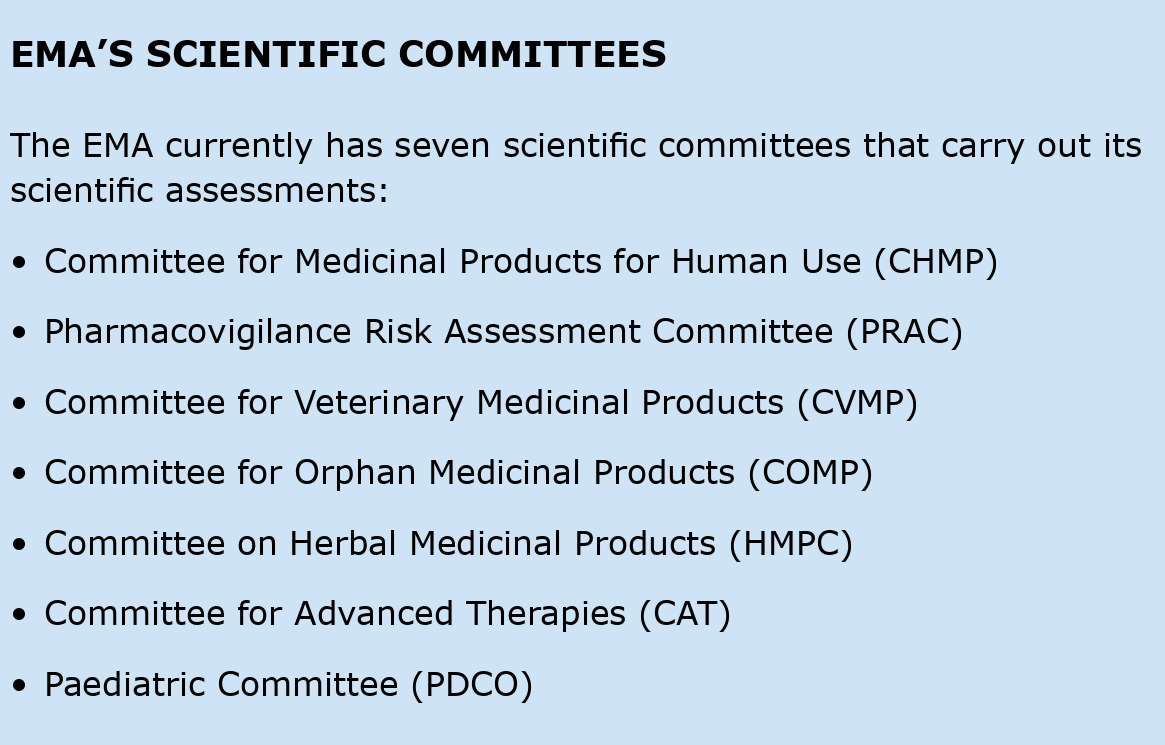
EMA fulfills its functions through its 7 scientific committees, as well as numerous Working Parties (WPs) and Operational Expert Groups (OEGs).
HMA
The Heads of Medicines Agencies (HMA) is a network of the heads of the National Competent Authorities (NCA) whose organisations are responsible for the regulation of medicinal products for human and veterinary use in the European Economic Area.
Main Activities
The HMA:
addresses key strategic issues for the network, such as the exchange of information, IT developments and sharing of best practices
focuses on the development, co-ordination and consistency of the European medicines regulatory system
ensures the most effective and efficient use of resources across the network. This includes developing and overseeing arrangements for work-sharing
co-ordinates the mutual recognition (MRP) and decentralised procedures (DCP).
There are two registration pathways for medicines to obtain marketing authorization in the European market:集中程序(Centralized procedure)、分散程序(Decentralized procedure)、互认程序(Mutual recognition procedure)及国家授权程序(National procedure)。